 Tasselline | Latest Articles By Singaporeans, for Singaporeans Article Site for Singaporeans
Mosquito fogging and larviciding do different things. If you have adult mosquitoes, you will need to do fogging. If you have active mosquito breeding, you will need to treat mosquito larvae using larvicide treatment in water-holding areas.
The appropriate control method would depend on what is discovered at the property. Professional mosquito management in Singapore begins with a clear identification of whether you are battling adult mosquitoes, active breeding or both.
A treatment should be appropriate to the source of the problem. Adult mosquitoes may require a different form of treatment than breeding larvae in water where it is being retained. In some instances, both may be used within a broad mosquito management.
What Is Mosquito Fogging?
Fogging involves spraying the insecticide in the form of a cloud of very fine droplets to kill adult mosquitoes within a specific area. It is not designed to kill mosquito eggs or larvae developing in water.
Mosquito fogging in Singapore could be carried out if a property inspection finds the presence of adult mosquitoes. Consider also plantation areas, patches of thick foliage and corners or spaces that are sheltered from wind or other mosquitoes' resting places. Fogging does not eliminate mosquito breeding sources. These should be targeted individually.
What Is Larviciding?
Larviciding targets the mosquito in the pre-adult stage. A larvicide treatment is done to all water-holding sites that are suitable for larvae and where breeding can take place. One may consider this method when water is not readily drainable or alterable. Some drains, fixed water features, or hard-to-reach positions require additional evaluation. Source removal should always be the preferred option where feasible. Any source which can be simply emptied or removed may not need treatment.
Mosquito Fogging vs Larviciding
The two approaches focus on distinct parts of the mosquito life cycle.
|
Factor |
Mosquito Fogging |
Larviciding |
|
Main target |
Adult mosquitoes |
Mosquito larvae |
|
Treatment focus |
Existing mosquito activity |
Suitable water-holding areas |
|
Main purpose |
Addresses adult mosquito presence |
Targets larvae before adulthood |
|
Application |
Selected areas |
Identified water sources |
|
Source removal |
Does not replace source removal |
Does not replace source removal |
|
Role |
May reduce adult mosquito activity |
May address breeding at the larval stage |
The decision to use between the two will be made on the conditions encountered during inspection. The mosquito control in Singapore should be practical enough to target the actual problem instead of treating every site the same way.
When Is Fogging Appropriate?
Fogging can be done where established adult mosquitoes are present, and the survey indicates a requirement to treat them. Factors to consider include the area size, activity levels and the area's surroundings.
Mosquito fogging in Singapore might be suitable for some properties where adult mosquitoes are present around outdoor areas. It should not be regarded as a permanent treatment if breeding sources are nearby.
New mosquitoes can still hatch if larvae are still developing in the water left behind. This is the main reason that inspections should be carried out before and after treatment.
When Is Larvicide Treatment Appropriate?
Larvicide treatment is appropriate if water cannot be drained. It is used where the area needs control of mosquito larval breeding. An inspection of the condition and type of water should take place in the first instance.
Examples may include:
-
Certain drains and drainage structures
-
Permanent water features
-
Difficult-to-access water-holding areas
-
Places where mosquito larvae were found
-
Where water can't be regularly emptied
Can Both Methods Be Used Together?
Yes. It is possible to have adult mosquito activity and an abundance of mosquito breeding sites on the same property. These two problems may need to be treated independently.
Fogging would generally be designed for adult mosquitoes, and larviciding would target larvae in identified breeding sites. This combined approach may form part of broader mosquito management where site conditions support the use of both methods. Note that one should not handle only one stage and neglect the other active source. The result of the inspection should be used to decide what to deal with.
What Factors Affect the Choice?
Several factors can influence the treatment approach:
-
Presence of adult mosquitoes
-
Presence of mosquito larvae
-
Type of water source
-
Whether water can be removed
-
Accessibility of the area
-
Drainage conditions
-
Vegetation and sheltered spaces
-
Size of the property
-
Recurring mosquito activity
-
Changes after rainfall
These factors can help to decide if mosquito fogging in Singapore, source removal, larviciding, or a combination might be appropriate.
Why Is Source Identification Important?
Discovering the source helps you decide what actions to take. A mosquito problem might have more than one location, and some breeding areas are not easy to see.
An inspection will locate containers, drains, gutters, depressions in the ground and other areas where water collects. Wherever possible, eliminate the breeding sites by removing the water source.
If water cannot be pumped out, examine the water for condition to see if a larvicide treatment could be justified. This becomes more like a targeted approach rather than just treating blindly.
What Does Mosquito Management Involve?
Effective mosquito management takes more than just one treatment. It takes a site inspection and a response to the current conditions.
A practical process may include:
-
Look for water-holding spots.
-
Eliminating water sources that are of no use.
-
Checking locations where water remains.
-
Identifying potential mosquito breeding sites.
-
Monitoring adult mosquito populations.
-
Choosing appropriate treatment options.
-
Performing periodic property inspections.
This approach can address current activity while also identifying conditions that may support future mosquito breeding.
Which Method Is Right?
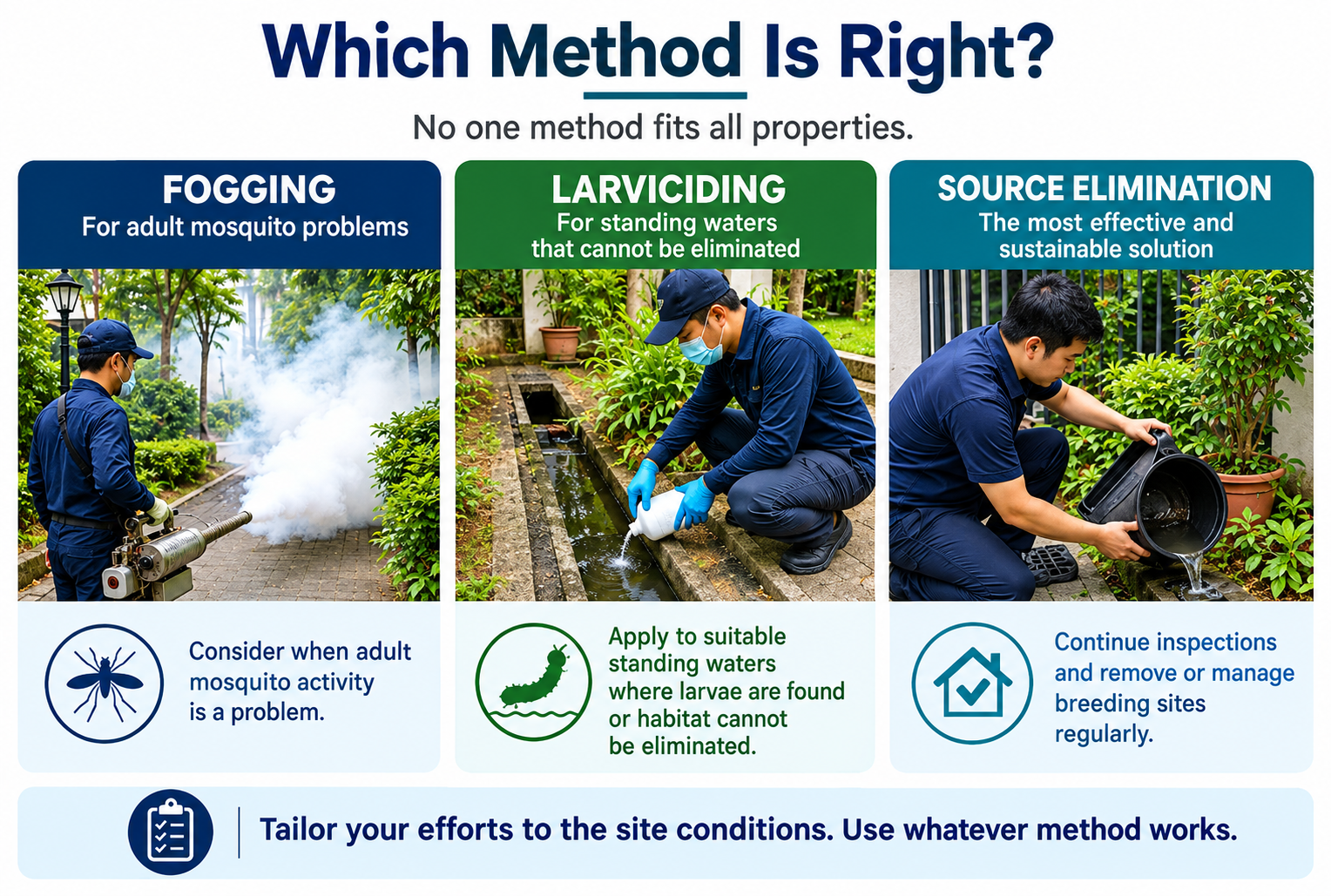
No one method fits all properties. Fogging could be considered where adult activity presents a problem. Larviciding may be applicable for suitable standing waters where larvae are found, or the habitat cannot be eliminated.
For continuous mosquito control in Singapore, ongoing inspections and source elimination should continue to be emphasised. The most effective mosquito management is to tailor your efforts to the site conditions. Use whatever method works.